Paying Artists - Directing Thesis
Columbia will provide standardized $500 stipends to the Scenic, Lighting, Sound, Props, Projection, and Costume Designers. These stipends are separate from the discretionary budget.
Additional artist fees are expected to come from the discretionary budget of the production. Artists may also be paid via fundraising if the production chooses to fundraise.
To avoid inequity and unjustified discrepancies for the salaries of members of the creative team, all Columbia productions must adhere to the following rules regarding paying people who work for the production.
- Columbia will provide a $500 designer stipend to the Scenic, Lighting, Sound, Props, Projection, and Costume Designer.
- No member of the creative team can receive a payment greater than $500. This includes non-student designers, producers, directors, and choreographers.
- If an A1 is hired, they must be paid on par with the designers.
- Actors may receive a payment up to $500; however, that amount must be the same for all equally tiered participants (i.e. principal, secondary, chorus). In other words, all principals must all be paid the same, secondary roles the same, etc. The student director/playwright and Producer can indicate which roles fall into each of these categories.
All artists being paid must have a signed contract, performance agreement, and/or payment paperwork in place before beginning work.
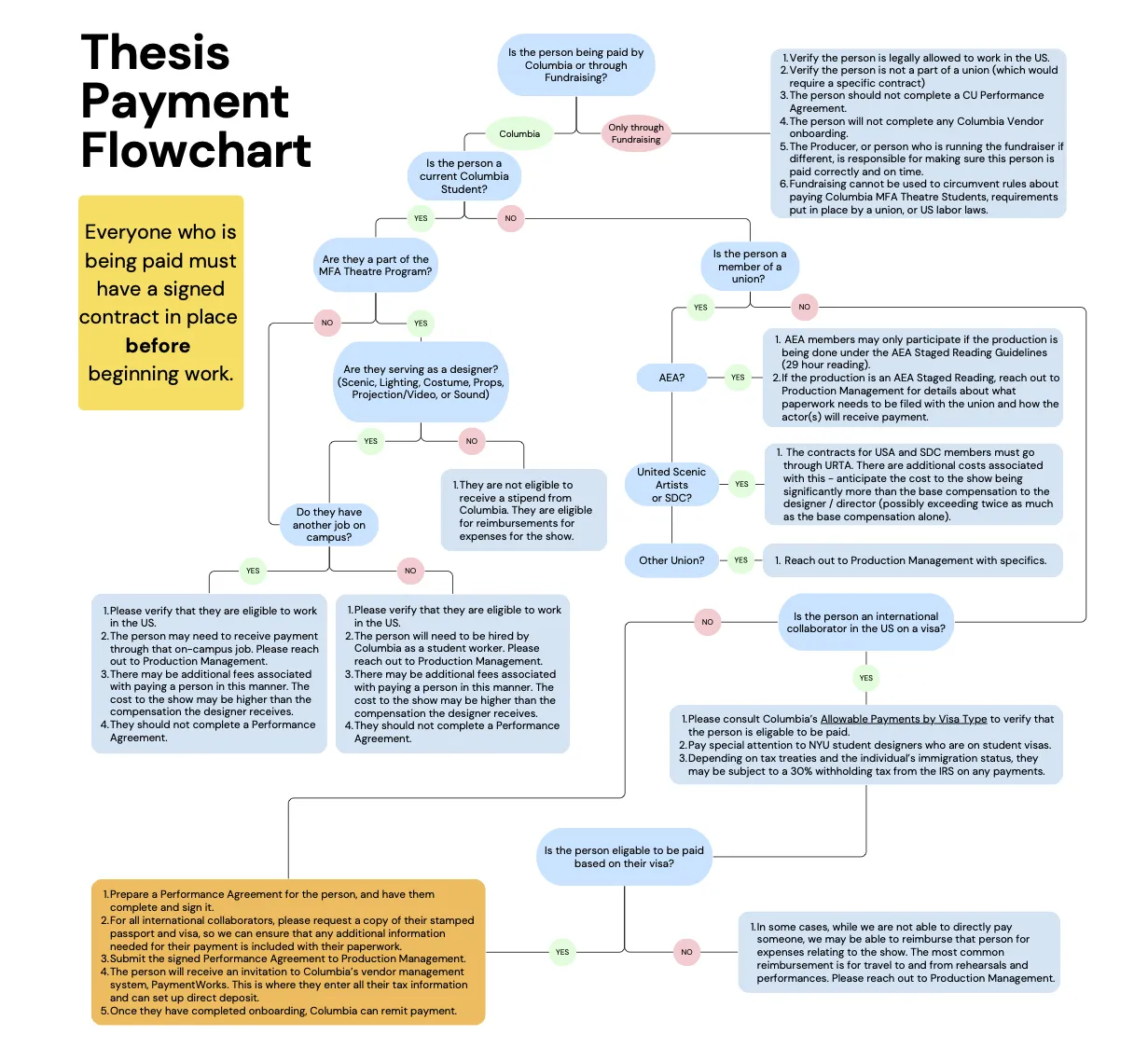
There are several key questions to ask that will determine if a given artist is eligible for payment and what paperwork and process needs to be followed.
Is the artist an international collaborator?
If so, please consult Columbia's Allowable Payments by Visa Type to ensure that the artist can be paid. Performance Agreements fall under the Supplier of Goods and Services column. Depending on tax treaties and the individual’s immigration status, international collaborators may be subject to a 30% withholding tax from the IRS on any payments. Please pay special attention to designers who are in the US on student visas - the sponsoring organization matters for payment eligibility. It is of upmost importance to confirm visa status before an artist begins work - failure to do so will result in significant delays in the artist receiving payment, or in some cases could expose the artist to legal issues that could impact their visa and immigration status.
Is the artist a current student at Columbia?
If a Current Columbia MFA Theatre Student is working on a show that is not a curricular requirement, they are eligible to receive payment if they are serving in one of the following six design positions on a show:
- Scenic Designer
- Costume Designer
- Lighting Designer
- Props Designer
- Sound Designer
- Projection / Video Designer
These are the only creative team positions that current Columbia MFA Theatre students are eligible to be directly paid for. This policy reflects that while Columbia does not offer MFA classes relating to Theatre Design, some students may have professional-level skills they bring with them from outside experience. CU Students are never eligible for payment if they are participating on the show as part of a curricular requirement.
If a student at Columbia is not an MFA Theatre student (e.g., they are an architecture student or enrolled as an undergraduate Barnard) they are eligible to receive payment as if they were an outside collaborator.*
*Please note that the process for hiring a current student is different from hiring an outside collaborator. We will need to know if the student has an existing job on campus. Paperwork must be completed before work begins - the structure of Columbia’s system for hiring students does not allow for students to be paid retroactively.
Is the artist a member of a union?
AEA may only participate in Columbia productions if the show is being produced under the AEA Staged Reading Guidelines.
Members of United Scenic Artists or SDC must be paid via contracts through URTA. There are additional costs associated with this - anticipate the cost to the show being significantly more than the base compensation to the artist (please consult this URTA Union Fee Calculator for an estimate of the total cost.)
SAG-AFTRA membership is not relevant to live theatre performance.
For any other relevant unions, please reach out to Production Management with specifics.
What if someone is not eligible for payment?
In some cases, while we are not able to directly pay someone, we may be able to reimburse that person for expenses relating to the show. The most common reimbursement is for travel to and from rehearsals and performances. It is best to retain your complete itemized receipts along with proof of payment. For international collaborators, please consult the Expense Reimbursement column on Columbia's Allowable Payments by Visa Type for the individual's visa.
The payment process and paperwork required for payment falls into 4 basic categories:
- Artists paid via Performance Agreements: This process will cover the vast majority of outside collaborators. Full details are below under Instructions for Performance Agreements.
- Artist paid entirely from fundraised funds: The Producer, or person who is running the fundraiser if different, is responsible for making sure artists are paid correctly and on time from fundraised funds. These artists should not fill out a Columbia Performance Agreement, as they are not entering into a contract with Columbia. It is recommended that a written agreement be drawn up between the artist and the person running the fundraiser defining the payment. Fundraising cannot be used to circumvent rules about paying Columbia MFA Theatre Students or requirements put in place by a union.
- Artists who are members of a relevant union: These artists need to have specific contracts in place. Most of these will need to be filed through URTA. There are significant extra costs associated with hiring union artists.
- Artists who are current Columbia Students: Columbia Students who are eligible to be paid have a separate process to be hired. Most of the paperwork is internal to the SOA Business Office, and so will be handled directly by Production Management. Production Management will be in contact with the Producer about any information needed.
For all International Artists: please consult Columbia's Allowable Payments by Visa Type to ensure that the artist can be paid. Performance Agreements fall under the Supplier of Goods and Services column. Depending on tax treaties and the individual’s immigration status, international collaborators may be subject to a 30% withholding tax from the IRS on any payments.
In some cases for International Artists, Columbia University will be unable to pay on a performance agreement and will instead need to pay the artist through NextSource as an outside contractor. NextSource payments are not processed with a performance agreement but rather through the NextSource temp agency. These payments are subject to an additional 31% fee on top of the payment. For example, if you are paying an artist $100 and they are paid through NextSource, the artist would be paid $100 but the production would need to pay $131 and the additional $31 would come out of the production's budget.
*Photographers and Videographers specifically have very different paperwork and insurance requirements, including a Non-PO Photographer Agreement with Insurance Option. Please coordinate with Production Management if for any reason the production would to hire a photographer in excess of the one provided.
Most artists and collaborators who are being paid on thesis productions will be paid via a Performance Agreement.
This contract should be prepared by the Producer on the production, with the following in mind:
- The name listed on the Performance Agreement must match the legal name of the individual as it would appear on their tax documents. If a person has a preferred name that doesn't match their legal name, you can list that name as FIRST LAST (aka PREFERRED NAME) or FIRST LAST (credited as PREFERRED NAME).
- The Producer should fill out most of the information on the first page before sending it to the artist to be signed. This includes the Dates of the Performance, Name of the Performance, Type of Performance, Times, and, most importantly, the agreed upon Wage.
- Remember to have the artist include their address in the lines on top of page 3.
- Once the artist signs the Performance Agreement, send it to Production Management.
- If the artist is an international collaborator, please submit a copy of their visa and stamped passport with the signed Performance Agreement to ensure they can be on-boarded properly.
- No member of the production or creative team can sign a Performance Agreement on behalf of Columbia - the contract must be executed by Columbia Procurement Services only.
An example of a completed Performance Agreement can be found here: Example Completed Lenfest Performance Agreement.
Once the Producer has the signed Performance Agreement, please submit it to Production Management promptly using the Performance Agreement Submission Form. There is no need to wait to send all the Performance Agreements for a production all at once. It is much better to start the process of getting artists paid as quickly as possible.
Every person that submits a Performance Agreement or requests a reimbursement will need to create a Vendor Profile with the university. This is done through a platform called PaymentWorks. Production Management will notify the individual when they have requested that the individual be added to PaymentWorks and what to expect in that invitation.
The timeline from the moment we receive a signed Performance Agreement and payment being issued to the artist can take 6 weeks (or longer in some cases), depending on their on-boarding status at Columbia. For a detailed map of the on boarding process, please see the section below: Understanding the Payment Process for Outside Individuals.
Below is the step by step process for how outside artists can be paid for their work on Columbia productions. The Producer will provide the artist with the Performance Agreement to sign, and collect both the Performance Agreements and any additional required documents for all outside artists on their production to be turned into Production Management.
This overview is only for collaborators being paid directly by Columbia (i.e. not paid entirely through fundraising) who are not CU affiliates or members of a union. If a person is a CU Student or Affiliate, or a member of a union such as AEA, United Scenic Artists, or SDC, please reach out to Production Management for specific instructions.
Step 1. The person being paid should review the provided Performance Agreement and fill in any information not pre-filled by the Producer. They should sign and date the last page. For names: list the legal name of the person as it appears on tax documents and their government issued ID. If they have a preferred or stage name, they can be listed as “First Last (credited as Preferred name)” or “First Last (aka Preferred name)”.
Step 2. Submit the signed Performance Agreement to Production Management using the Performance Agreement Submission Form. No outside collaborators should begin work or rehearsal without a signed agreement in place. International Collaborators submit a copy of their visa and stamped passport with the signed Performance Agreement to ensure they can be on-boarded properly.
Step 3. Once Production Management receives these materials, we review them and submit them to the Finance Department.
Step 4. After the Finance Department receives the materials, the person being paid will receive an email inviting you to PaymentWorks, Columbia’s Vendor Management system. The registration process is pretty quick and easy, usually taking about 15 minutes, but if there are any questions, detailed instructions can be found here: Columbia University - Registering as a Vendor. If someone already has a PaymentWorks account from another employer or job, instructions for how to link Columbia to that account can be found on page 7 of this link: Columbia University Vendor Onboarding. More information about Columbia Vendor Management can also be found on the Columbia Finance Website.
Note: The two common questions we receive about registering as a vendor are:
- The Vendor Classification choices in Additional Information. Under 1099 Tax Information for Individuals, please select “Non-employee compensation”, and under Vendor Classification, please select “Supplier of Goods and Services”.
Under Payment Information: "ACH" means Direct Deposit. If you would prefer a regular check, please select "No ACH" and then "Check" in the box that appears. (In general, direct deposit is faster.)
Step 5. Once they have completed their registration in PaymentWorks, their vendor profile will be reviewed by Columbia Finance. This step in the process typically takes 2-3 weeks, but in certain cases may take 8 weeks or more. They will be notified when it is complete. If there are any issues with their registration they will receive an email with specific instructions as to how to correct those issues or what additional information is required.
Step 6. Once they are registered in the system, your payment can be processed and issued. This final step again typically takes 2-3 weeks, but in some cases may take longer.
IMPORTANT THINGS TO NOTE
- We completely understand these steps seem burdensome to some. However, Columbia University has to verify and approve all work & payment authorization for outside artists in accordance with IRS regulations for all individuals and, in the case of international individuals, Dept. of Homeland Security, U.S. Citizenship & Immigration Service.
- Early submission is always best. Payment will be delayed if the above steps don’t begin until later in the process.
- PaymentWorks is an automated email address, please make sure to check your spam folder.
- We are unable to provide an ETA on when checks will be mailed. The best way to ensure timely payment is to complete the steps as early as possible.
- If someone has already completed vendor onboarding from previous work at Columbia, they will not need to complete the PaymentWorks registration again and will not receive an invitation to register. If someone is unsure if they have completed vendor onboarding previously, they can search for their name in the Vendor ID Lookup.
- For help on issues with PaymentWorks, please email [email protected].
Performance Agreements: Form 1099-MISC is used to report payments made to a person or business that is not being paid as an employee of Columbia University. These payments are called “non-employee compensation”. Form 1099-MISC is required ONLY when total payments for the year exceed $600. The form is provided by the University to the IRS and to the person or business that received payment. It will be mailed to recipients by January 31st of the following year.
International Collaborators: Depending on tax treaties and the individual’s immigration status, international collaborators may be subject to a 30% withholding tax from the IRS on any payments.